

Financial Basics Everyone Should Know
Build a stronger financial foundation by understanding the basics


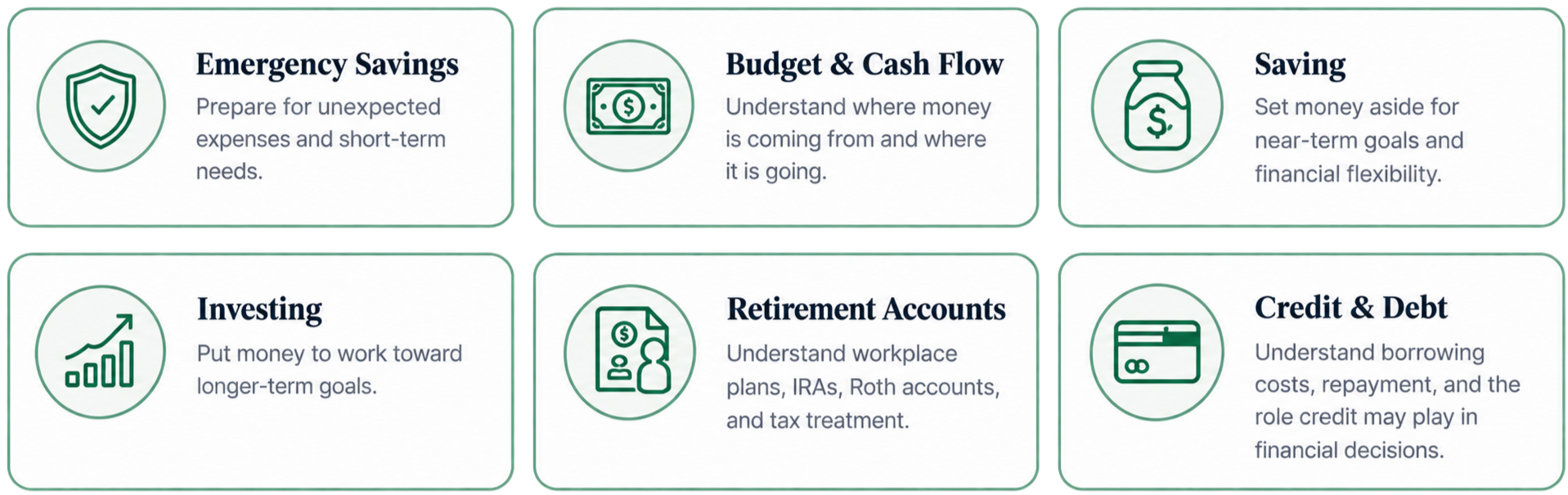
A Strong Financial Foundation Has Several Pieces
Build Your Financial Knowledge
Financial Basics Planning Guides
You do not need to be a financial expert to make thoughtful decisions. Our Financial Basics Everyone Should Know Series provides educational resources designed to help make common financial topics easier to understand.
-
![]()
Savings vs. Investing
Learn how saving and investing serve different purposes and how each may fit into short-term and long-term financial goals
-
![]()
Traditional IRA vs. Roth IRA
Understand some of the key differences between Traditional and Roth IRAs, including how contributions and withdrawals may be treated.
-
![]()
The Power of Compound Interest
Explore how time, consistency, and reinvested growth can affect savings and investments over the long term.
-
![]()
Understanding Your 401(k) or Other Workplace Retirement Plan
Review common features of workplace retirement plans, including contributions, employer matching, investment choices, and plan rules.


Before Making a Financial Decision, Ask Yourself

What Is the Goal?
We help estimate what you are trying to accomplish and how soon you may need the money

What Are the Tradeoffs?
Consider access to the money, taxes, potential growth, risk, and other limitations

How Does It Fit With Everything Else?
A good decision in one area should still make sense alongside your other financial priorities.

What Happens Over Time?
Consider how the decision may affect your finances not only today, but several years from now.
Financial Basics FAQs
-
Saving is generally used for money you may need in the near term and often emphasizes accessibility and stability. Investing typically involves accepting some level of risk in pursuit of longer-term growth.
-
Compound interest refers to earning returns not only on the money you originally save or invest, but also on previous earnings. Over longer periods of time, this compounding effect can become significant.
-
Both are retirement accounts, but they differ in areas such as tax treatment, eligibility, contribution rules, and withdrawals. Which may be appropriate depends on your individual circumstances.
-
A 401(k) is an employer-sponsored retirement plan that allows eligible employees to contribute a portion of their pay toward retirement. Some employers may also provide matching contributions.
-
Diversification is a time-tested investment approach that spreads investments across different asset classes and market segments, helping create a more balanced portfolio.
-
No. One of the purposes of financial guidance is to help you better understand the areas that affect you. Asking questions is an important part of the planning process.